














































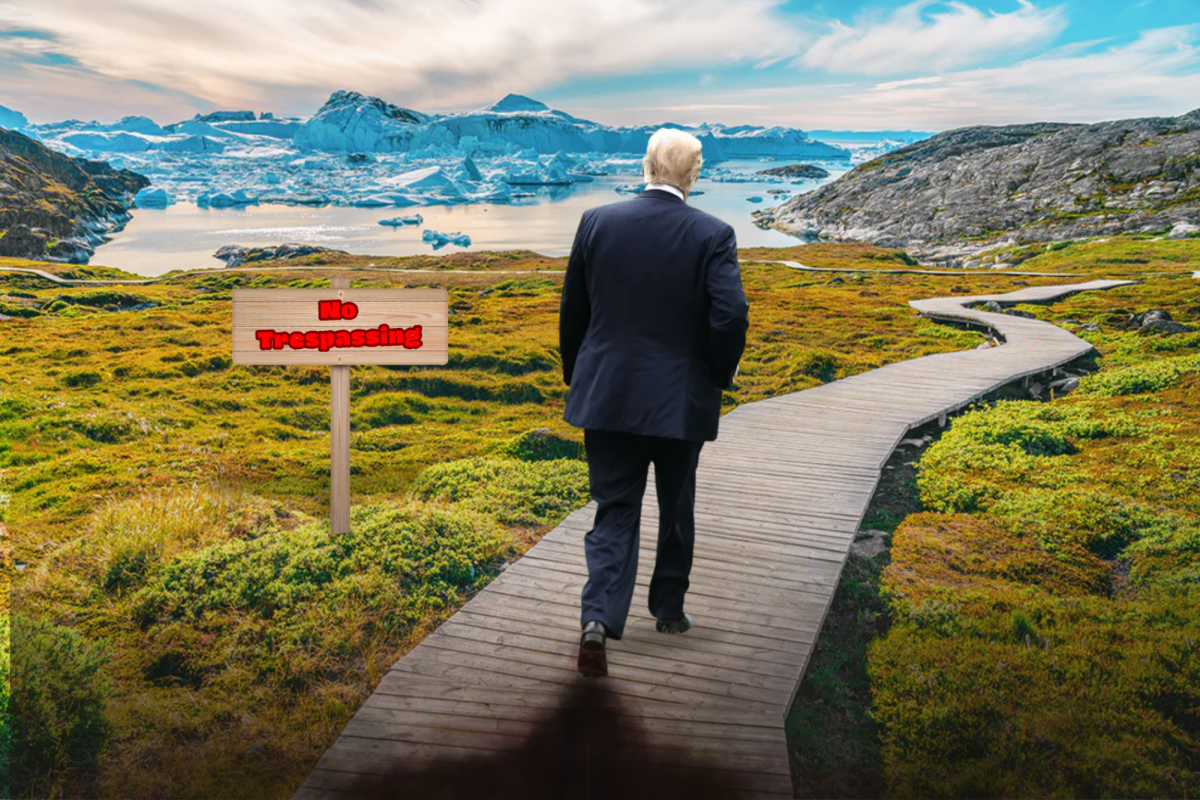













The U.S. should not continue its efforts in attempting to take Greenland from Denmark, and President Donald Trump should be more diligent in what foreign discussions he involves America in.
During discussions of Trump’s foreign policy, the idea of the United States taking control of Greenland has once again resurfaced.
While supporters argue that acquiring Greenland would benefit U.S. national security and economic interests, the United States should not pursue the annexation of Greenland because doing so would violate national independence, damage relationships with European allies, increase geopolitical instability, and unfairly disregard the Indigenous Inuit people who have lived on the island of Greenland for thousands of years
Attempting to take control of Greenland would disregard their national independence and would weaken diplomatic relations with Denmark and Europe as a whole.
Reuters reported, “Greenland’s Prime Minister reaffirmed that the island’s loyalty lies with Denmark,” making it clear that Greenland is not seeking U.S. ownership or intervention.
Since Greenland is a self-governing territory within the Kingdom of Denmark, its future cannot and should not be decided by foreign governments like the US.
Ignoring Greenland’s leadership undermines democratic choice, a principle the United States claims to champion abroad.
Pursuing control would also set a dangerous example, signaling that powerful nations can override smaller ones for strategic gain.
An example of this globally is China’s push to gain control of Taiwan, which has been independent of China since 1949.
Beyond sovereignty concerns, the push to acquire Greenland risks damaging U.S. relationships with European allies, particularly Denmark.
At the World Economic Forum’s Annual Meeting, President Trump has said that “it’s the United States alone that can protect this giant mass of land… and make it safe for Europe and good for us.”
This rhetoric suggests that Denmark and other European nations are incapable of managing their own security, an implication that many allies find dismissive.
According to NATO officials and European leaders cited by the Associated Press, “cooperation… not control, has long been the foundation of Arctic security.”
Strong alliances depend on mutual respect, not territorial ambition.
Continued pressure on Denmark could lead to diplomatic fallout, weakening cooperation on defense, trade, and climate policy.
Supporters of annexation also claim Greenland would bring economic and strategic stability, yet even Trump’s own descriptions highlight the uncertainty of the proposal.
He has referred to Greenland as “a piece of ice, cold and poorly located,” while also claiming it plays “a vital role in world peace and world protection.”
This contradiction shows how unclear the benefits actually are.
Acquiring Greenland would require massive financial investment, complex governance changes, and long-term political negotiations.
Rather than increasing stability, such a move would likely introduce new conflicts and economic strain for both the United States and its allies.
This tension has already been seen through other conflicts that are similar in nature to that of Greenland, such as Venezuela.
While Trump has not directly stated the obtaining of oil as his main motive for the capture of the Venezuelan president, Nicholas Maduro, and the fight for Greenland, many have speculated that the continuous need for oil and rare earth minerals in America is a driving factor in the battles that the federal government has decided to fight.
This sentiment is not unfounded and is definitely a commonality between the two political pushes that Trump has fought for.
Moreover, pursuing control of Greenland threatens the rights, culture, and identity of the Indigenous Inuit people who make up the majority of the island’s population.
As reported by Reuters, Greenlandic Inuit resident Ulrik Blidorf explained, “In Greenland, you can’t own the land… You only have the right to use the area where you live.”
For Inuit communities, land is not a commodity but a shared foundation of culture and survival.
Treating Greenland as something that can be bought or claimed by a foreign power dismisses Indigenous voices and continues a long history of outsiders making decisions for native populations without consent.
History shows that such disruptions almost always end in harm, not progress.
However, some supporters argue that acquiring Greenland would strengthen U.S. national security and counter foreign influence in the Arctic.
At the World Economic Forum, Trump has insisted that he “doesn’t have to use force” and “won’t use force.” However, even without military action, pressure from a global superpower can still be pressuring.
The United States already maintains a military presence in Greenland through agreements with Denmark, demonstrating that American interests can be protected through cooperation rather than ownership.
Security does not require annexation; it requires partnership.
The United States should not attempt to take control of Greenland.
Doing so would violate sovereignty, weaken alliances, increase instability, and disregard Indigenous rights.
Respecting international law and working collaboratively with Denmark, Greenland, and Inuit communities is not only the ethical choice, but it is also the smarter and more effective path forward.
